Making Your Case the Art of Persuading Judges Pdf Free
Features
Making Your Example


Bryan Garner and Antonin Scalia.
Photo past Steve Petteway,
Collection of The Supreme Court of the United states
In his 21 years on the U.S. Supreme Court, no one has seriously accused Justice Antonin Scalia of existence unable to limited himself. Cass R. Sunstein, the University of Chicago law professor, has likened his writings to those of Justices Robert H. Jackson and Oliver Wendell Holmes. University of Wisconsin police professor Ann Althouse says she "constantly dearly" wishes Scalia's colleagues had his sense of wit and fashion.
From the bench he's an acute—and sometimes withering—questioner. On the printed page, he's a direct and engaging writer. And from the lectern he'southward a smooth and self-assured orator—a cocky-professed fan of harsh truths skillfully articulated, even when they are non his own.
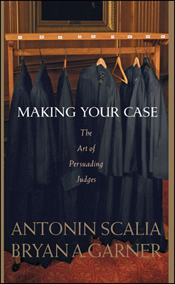
In his new book, Making Your Case: The Art of Persuading Judges, Scalia teamed with Bryan A. Garner, editor-in-chief of Blackness'south Law Dictionary. Excerpted here, the book reveals ways in which clear writing, articulate speaking and—above all—articulate thinking can help you lot make your case.
—Allen Pusey
WRITING THE Cursory
Value clarity to a higher place all other elements of manner In brief-writing, one feature of a skillful style trumps all others. Literary elegance, erudition, sophistication of expression—these and all other qualities must be sacrificed if they detract from clarity. This ways, for case, that the same word should be used to refer to a particular key concept, even if elegance of fashion would avoid such repetition in favor of various synonyms. It means that you must abandon interesting and erudite asides if they sidetrack the drive toward the point you are making. It means that you should never use a discussion that the judge may have to wait upward.
It means that nothing important to your argument should appear in a footnote.
Further, information technology ways shunning puffed-upwards, legalistic linguistic communication. Make your points and enquire for your relief in a edgeless, straightforward style.
Wrong:
The undersigned counsel do hereby for and on behalf of their clients, for the reasons explained hereinbelow, respectfully request that this Honorable Courtroom consider and hereby dominion that no problems of textile fact do exist in the instant controversy, and that a final judgment be entered in favor of the customer of the undersigned counsel (sometimes herein referred to as "Defendant" or "Cantankerous-Plaintiff") and against Plaintiff.
Right:
Johnson requests entry of summary judgment.
Clarity is amply justified on the ground that it ensures you'll be understood. But in our antagonist system it performs an additional function. The clearer your arguments, the harder it volition exist for your opponent to mischaracterize them. Put yourself in the shoes of a lawyer confronting an opposing cursory that is almost incomprehensible. Y'all struggle to figure out what information technology ways—and and then does the court. What an opportunity to characterize the opposing argument in a way that makes it weak! This tin't happen to you—your opponent volition not be able to distort what y'all say—if you are clear.
Utilise PARAGRAPHS INTELLIGENTLY; SIGNPOST YOUR ARGUMENTS
Department headings are not the only means of mapping your argument. Within each captioned section, paragraph breaks perform the same function. The first sentences of paragraphs (your fifth-form teacher chosen them "topic sentences") are as important as captioned section headings in guiding your readers through your cursory—telling them what next thought is well-nigh to be discussed. Paragraph breaks should not occur randomly, inserted simply because the last paragraph was getting also long. They should occur when you lot are moving on to a new subpoint and wish to signal a change of topic.
One writer on cursory-writing (who must remain nameless) suggests that no paragraph should be more than five sentences long. We call back that's bad advice. Your readers didn't make it to the bench by reading merely Classic Comics. Judges are accustomed to legal argumentation, which ofttimes—indeed, commonly—requires more than five sentences to develop an idea. Apply equally many sentences equally the idea demands. If the paragraph is condign unusually long (say a page of your brief), interruption the idea into two paragraphs if possible. (¶ "Another factor leading to the aforementioned conclusion … .") Some ideas will take but five sentences—indeed, some may take merely three. But a brief with paragraphs of rigidly uniform length is near certain to be a bad cursory.
USE WHAT IT TAKES
In helping the reader follow the progression of thought —both between and within paragraphs—guiding words are essential. Consider the difference between the following two progressions: (1) "He is non a great sprinter. He came in third." (ii) "He is not a great sprinter. But he came in tertiary." The word but signals that the next thought will somehow authorize the point just made. Or your second judgement might take been "Afterward all, he came in 3rd"—the Later all signifies that the upcoming thought will affirm the previous one. Or you might have used a subordinating conjunction: "Although he is not a great sprinter, he came in third."
There are many such guiding words and phrases: moreover, however (preferably not at the caput of a sentence), although, on the other hand, nonetheless, to prove the point, etc. These words and phrases turn the reader's head, and so to speak, in the management you want the reader to expect. Good writers use them abundantly.
Unremarkably, the very all-time guiding words are monosyllabic conjunctions: and, but, nor, or, and then and yet. Professional writers routinely put them at the head of a sentence, and and then should you. At that place's a myth abroad that y'all should never begin a judgement with a conjunction. Just look at any species of reputable writing—whether information technology'southward a adept newspaper, journal, novel or nonfiction piece of work—and you're probable to observe several sentences per page beginning with i of those lilliputian connectives. You can hardly achieve a flowing narrative or argument without them.
To clarify abstract concepts, requite examples. Legal briefs are necessarily filled with abstract concepts that are hard to explain. Cypher clarifies their meaning as well as examples. One can describe the interpretive canon noscitur a sociis equally the concept that a word is given significant past the words with which it is associated. But the reader probably won't really grasp what y'all're talking nigh until y'all give an example like to the ane we gave before: "pins, staples, rivets, nails and spikes." In that context, "pins" couldn't refer to lapel ornaments, "staples" couldn't refer to standard foodstuffs, "nails" couldn't refer to fingernails, and "spikes" couldn't refer to hairstyles.
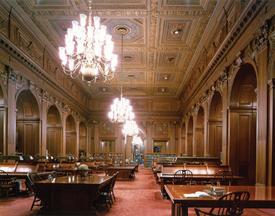
Photo by Franz Jantzen,
Collection of the Supreme Court of the U.s.a.
MAKE IT INTERESTING
To say that your writing must exist clear and brief is non to say that it must be slow. Of class, you lot should employ the usual devices of effective writing: simile, metaphor, understatement, illustration and antonym. But you shouldn't use these or other devices of style for their own sake. They are helpful merely if they crusade the serious legal points you're making to be more vivid, more lively and hence more than memorable.
Three simple ways to add interest to your writing are to enliven your word choices, mix up your sentence structures and vary your sentence lengths. With words, ask yourself whether at that place's a more than colorful way to put it. With sentences, guard confronting falling into a monotonous subject-verb-object heat—peculiarly when it's the same discipline, judgement after sentence. And call up that an occasional arrestingly short judgement can deliver existent punch ("This wolf comes as a wolf.").
Blackball jargon, hackneyed expressions and needless Latin. By "jargon" we mean the words and phrases used nigh exclusively past lawyers in place of plain-English words and phrases that limited the same thought. Jargon adds goose egg just a phony air of expertise. A nexus, for example, is cypher more than or less than a link or a connection. And what is the instant case? Does it have anything to practice with instant coffee? Alas, to tell the truth, it's no different from this instance or even here.
Write normal English. Such as a demonstrative adjective (such action) tin almost always be replaced with the skilful old normal English this or that. And hereinbefore with earlier. And pursuant to with nether. The primal is to avoid words that would cause people to look at you funny if yous used them at a party. Pretend that y'all're telling your story to some friends in your living room; that's how you should tell it to the courtroom.
Give the reader credit for having a brain—and evidence that y'all accept ane, too. Don't go out your common sense at the door. If your brief repeatedly refers to the secretarial assistant of transportation and mentions no other secretary, it is silly to specify parenthetically, the first time yous mention the secretary of transportation, "(hereinafter 'the secretary')." No i will think that your later on references to "the secretarial assistant" announce the secretary of defense, or possibly your own secretary.
Hackneyed expressions are exact formulations that were wonderfully vivid when starting time used, but whose vividness—through overuse—no longer pleases but bores. Such-and-such a case "and its progeny" is a adept example. Or the assertion that an statement is "fatally flawed" or "flies in the face of" something; that your adversary is "painting with a broad castor"; that a claim isn't "viable"; that the "parameters" of a rule aren't settled; or that something is truthful "beyond maybe of doubt." The examination is: Have you seen the brilliant phrase a lot? If and so, odds are it'south a cliché.
Some Latin expressions are convenient shorthand for rules or principles that take no English shorthand equivalent (res ipsa loquitur, for example, or inclusio unius est exclusio alterius). But avoid using other Latin phrases, such as ceteris paribus, inter alia, mutatis mutandis and pari passu. Judges are permitted to prove off in this fashion, but lawyers must not. And the judge who does not happen to know the obscure Latin phrase yous have flaunted will think yous a twit.
MAKING THE ARGUMENT
APPRECIATE THE IMPORTANCE OF ORAL ARGUMENT, AND KNOW YOUR OBJECTIVES
Many lawyers view oral argument as simply a formality, peculiarly in courts that make a exercise of reading the briefs in advance. Certain, information technology gives counsel a chance to show off before the client. Merely as far as affecting the outcome is concerned, what can twenty minutes or one-half an hour of oral statement add to what the judge has already learned from reading a few hundred pages of briefs, underlining pregnant passages and annotating the margins?
This skepticism has proved false in every written report of judicial beliefs nosotros know. Does oral argument change a well-prepared judge'due south mind? Rarely. What often happens, though, is that the judge is undecided at the time of oral argument (the instance is a close ane), and oral argument makes the divergence. It makes the difference because it provides information and perspective that the briefs don't contain.
A brief is logical and sequential. If it contains five points, they volition oftentimes be addressed in some logical social club, not necessarily in the social club of their importance. The amount of space devoted to each bespeak, moreover, has more to do with its complexity than its forcefulness. Someone who has read your brief, therefore—and especially someone who has read it some days agone—may have a distorted impression of your example. The reader may recollect that point No. one, which takes a third of your brief to explain, is the most significant aspect of your argument, whereas in fact signal No. three, which covers one-half as many pages, is really your trump menu. Oral argument tin put things in perspective: "Your Honors, we take four points to our brief, all of which we think merit your attention. Only the heart of our argument is point No. 3, on issue preclusion, and I'll turn to that at present."
Oral argument also provides information that the brief can't incorporate. Most obviously, it gives the appellee an opportunity to respond to responses and new points contained in the appellant's answer brief. At least as important, it provides both sides the opportunity to respond questions that accept arisen in the judges' minds.
The nigh obvious of these should have been anticipated and answered in the briefing, only repetition of the respond to a persistent doubter can exist helpful. And the judges are bound to have in mind questions unanticipated by the briefs—either because the answer is too obvious or because the question is too subtle. Oral argument is the fourth dimension to lay these judicial doubts to rest. And finally, the quality of oral argument can convey to the court that the brief already submitted is the product of a highly capable and trustworthy attorney, intimately familiar with the facts and the constabulary of the instance.
In descending guild of importance, your objectives in oral argument are these:
-
To answer any questions and satisfy whatever doubts that have arisen in the judges' minds.
-
To answer—if you're counsel for the appellee—new and telling points raised in the appellant's respond brief. Oral argument is your only chance.
-
To call to the judges' minds and reinforce the noun points fabricated in your cursory.
-
To demonstrate to the courtroom, by the substance and mode of your presentation, that you are trustworthy, open up and forthright.
-
To demonstrate to the court, past the substance and manner of your presentation, that y'all accept idea long and difficult well-nigh this case and are familiar with all its details.
-
To demonstrate to the court, mostly by the manner of your presentation, that you are likable and not mean-spirited.
HAVE YOUR OPENER DOWN PAT
Anyone who has done public speaking knows that the hardest role is the opener. Your adrenaline is pumping. You're trying to keep nervousness out of your phonation and manner, establish eye contact with your audience and projection a steady, even tone. This is no time to worry about what you're going to say. For this office of your presentation, commit your words to retention (though try non to deliver them as though by rote). Even for the opener, still, don't read from a prepared text.
Your opening should usually consist of, or at least contain, a brief outline of the subjects y'all intend to accost: "I hope to talk over this morn, first, why this court has jurisdiction, then why the trial court's finding of negligence was unsupported, and finally why the damages awarded are apparently excessive." You should exist under no illusion that you lot will actually become to reach all these subjects—that ultimately depends on the court (which is why you lot should put your strongest point first). Merely setting forth at the commencement the full range of what you hope to accost may induce the judges to make their questions more concise.
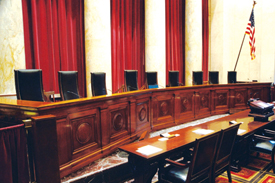
Photo by Franz Jantzen,
Collection of the Supreme Courtroom of the United states
Exist CAUTIOUS Near HUMOR
Never tell prepared jokes. They almost invariably bomb. In Roe v. Wade, an banana attorney general for the state of Texas, who was arguing against ii women lawyers, led with what he probably considered courtly Southern humour:
"Mr. Chief Justice, and may it please the court, information technology'south an quondam joke, just when a homo argues confronting two cute ladies like this, they're going to have the concluding word." No 1 laughed. Onlookers said that during an embarrassing silence, Main Justice Burger scowled at the advocate.
As for uncanned sense of humour, we have heard counsel with an easygoing sense of sense of humour break the tension and foster amicable soapbox by an unscripted witticism—always gentle and often cocky-deprecating. The problems are that (1) Only someone with a genuinely good sense of humor, and a feel for when sense of humour is appropriate, can pull this off; (2) Many of the states who think we accept those qualities don't; and (3) Some judges have no sense of sense of humour. All in all, the benefit is non worth the risk. You should, of course, brandish restrained appreciation for whatsoever attempt at humor past the court.
NEVER POSTPONE AN ANSWER
Perhaps the most annoying of all responses to a guess's question is this: "Your Honor, I'll go to that point later. Get-go, … ." Go where the court wants yous to go! Besides offending the court's dignity, you invite the approximate to conclude (as most will) that you have no effective response. And you lot invite suspicion that the promised "afterwards" will never come. (Justice John M. Harlan asserted that the usual result of a postponed answer was a never-addressed question.) At the very least the questioner is distracted from your ensuing give-and-take, waiting eagerly for that to be done with and for the question to be addressed. As elegantly described by Ben West. Palmer, a Minneapolis practitioner of the mid-20th century, "Everything you may say thereafter may be suspended in the air like a levitated body or more likely a corpse—the corpse of your dead case."
When post-obit our advice not to postpone an answer, refrain from maxim something like, "Your Honor, I was planning to accost that bespeak later on, just since you ask I shall come to it at one time."
Frankly, the courtroom doesn't care a fig whether you lot were planning to address information technology later on or not—you'll get no points for that even if the judges believe y'all. And the clear suggestion that the nasty ol' judge has ruined your orderly plan of presentation will not be well-received. Just answer the question.
LEARN HOW TO HANDLE A Hard Approximate
Yous will sometimes see a guess whose questions are designed non to obtain enlightenment just to demonstrate to colleagues the weakness of your case. During your commutation with such a questioner, exist sure to maintain eye contact. Don't display your discomfort by looking downwards at some imaginary text whence volition come your redemption. Look the estimate straight in the eye and proceed responding in a professional, firm manner.
It'due south always a mistake to evade questions, but especially and so when the question comes from a difficult judge. That judge will persist, and you'll end up spending even more than time reasoning with someone who will non be persuaded. Confront the question squarely with your best respond, and try to move on.
Sometimes such a questioner, later on you have answered equally best you can, will continue to press the same betoken, even though (indeed, because) y'all are unable to say annihilation more. You must devise a polite, nonalienating style to end this exchange, or it volition swallow much of your statement time. Later a decent corporeality of time has been spent on the point, information technology would be appropriate to say, "Your Honor, I cannot respond to your objection with annihilation other than what I have already said."
A similar problem is presented when a judge's questions most one role of your presentation are and then numerous that the time remaining for an of import but still-to-exist-addressed portion is growing curt. Yous must try, politely, to regain control of the subject matter. The court will not take it amiss if, after responding to 1 question, you keep quickly: "With the court'southward permission, I would similar to plow at present to … ."
Whatever else yous exercise when confronted by a hostile and unreasonable gauge, don't answer in kind. Don't become hostile yourself; don't display anger, badgerer or impatience. Keep telling yourself that yous owe it to your client—because you practice.
Even so, lawyers are entitled to take bully delight in the wonderful comeuppances to judicial boorishness that some of their more than rash predecessors take devised. Our favorite was also a favorite of Justice Robert H. Jackson. A noted barrister, F.E. Smith, had argued at some length in an English courtroom when the judge leaned over the bench and said: "I have read your instance, Mr. Smith, and I am no wiser than I was when I started."
To which the barrister replied: "Possibly non, My Lord, but far improve informed." Smith, who later became a famous judge equally the Earl of Birkenhead, could reportedly carry off such snappy rejoinders with impunity.
We doubt that, just in any instance we don't recommend that y'all emulate him.
BEWARE INVITED CONCESSIONS
We've brash you to volunteer concessions that conscientious deliberation shows are necessary. Merely concessions that y'all're pressed to make on horseback, at oral statement, are something else. The unduly accommodating lawyer—a frequently observed creature, specially in appellate courts—has given abroad many a case. The law books are filled with affirmances that would have been reversals or remands for further proceedings were information technology not for the concession of a crucial fact by accommodating counsel. And propositions of police that might well have been exceedingly hard for an opinion to establish take oftentimes been happily resolved (for purposes of the case at hand, at least) by foolish concessions.
Any judge who presses you for a concession might well apply information technology confronting you lot. That judge may, for case, be testing the validity of your basic premise—or rather, the fidelity of your adherence to that basic premise. Allow'south say you lot're defending the lawfulness of an officer's traffic stop on the footing that in that location was an objectively valid basis for the stop, such as a broken taillight on the vehicle. Counsel for the defense contends that the stop was unlawful because the existent reason for it was the officeholder's suspicion that the occupants of the car were drug-runners. You lot might get the post-obit honey-coated inquiry from the court: "Counsel, surely you lot would agree that an officeholder could non pull a car over—fifty-fifty a machine with a broken taillight—solely for the purpose of harassing its occupants."
What a wonderful opportunity for you lot to prove that you are just every bit reasonable a person as this gauge. But if you ascent to this bait, you volition take abased the fundamental premise of your case: that whatever the subjective motivation for a stop, it is validated by objective indication of likely cause. For beingness so accommodating, you can await the courtroom's opinion excluding the evidence derived in the traffic cease to read: "Counsel has best-selling that the subjective intent of the absorbing officer is relevant, and we see no divergence between an invalidating intent to harass and an invalidating intent to search for drugs without probable cause."
Information technology is non unusual for a judge to come to the bench, having read all the briefs, with a clear idea of what the judgment ought to be but for 1 missing fact, or but for ane possible legal obstacle. If the judge tin can get y'all to concede that fact, or to concede a point that would brand that legal obstacle irrelevant, the stance is all but written. You should not cooperate in your ain destruction.
Excerpted from Making Your Case: The Fine art of Persuading Judges, past Antonin Scalia and Bryan A. Garner. Published by Thomson/West (2008)
Reprinted with permission.
Additional coverage:
Exclusive ABA Journal interview
Podcast of the interview
Complete transcript
Within the interview
Give the states feedback, share a story tip or update, or report an mistake.
Source: https://www.abajournal.com/magazine/article/making_your_case
0 Response to "Making Your Case the Art of Persuading Judges Pdf Free"
Post a Comment